Writers At Risk

Writers At Risk

Writers at risk

Writing may look like a calm and creative profession from the outside, but behind the scenes many writers face physical and mental challenges caused by long hours at a desk. Writers at risk are those who engage in this highly sedentary occupation spending hours in front of a computer screen.

Sitting

Sitting for a long time in front of a computer screen can affect your body, your eyes, your posture, and even your mental wellbeing. If writers want long and productive careers, they need to take these hazards seriously.

Writers at risk sit for extended periods of time. Modern studies continue to warn about the health dangers associated with a sedentary lifestyle.

Sitting for too long can contribute to poor circulation, weight gain, stiffness, back pain, and reduced energy levels. Writers can easily become so immersed in their work that they forget to move for hours at a time.

Writing books has been my profession for many years so I’m very familiar with the dangers of this sort of activity. To counter the negative consequences of this sedentary lifestyle I have to actively build movement into my day.

Movement

Writers at risk

The solution is simple but important. Take regular movement breaks. Every 30 minutes, stand up and move around for one to three minutes. Stretch your legs, walk around the room, or do a few simple exercises.

Because writers often lose track of time while working, setting an alarm or timer can be helpful. These short breaks refresh both the body and the mind and can actually improve productivity and concentration.

Standing desk

Another helpful solution is investing in a standing or vertical desk. A writer can now alternate between sitting and standing while they work. Writing while standing can improve posture, reduce stiffness, and help combat the health risks linked to prolonged sitting.

Eye strain

Writers at risk


Eye strain is another common hazard which puts writers at risk. Most of a writer’s day is spent staring at a screen. Gazing at a computer for long periods without blinking enough can cause dry eyes, headaches, blurred vision, and fatigue. Over time, this can become a serious problem.

To protect your eyes, follow the “20-20-20” rule. Every 20 minutes, look at something 20 feet away for 20 seconds. Adjust your screen brightness, use proper lighting, and remember to blink regularly. Some writers also benefit from blue light filtering glasses.

Weight gain

Writing can also contribute to weight gain and obesity because the work requires very little physical movement. A healthy lifestyle outside writing hours is essential. Regular exercise, walking, healthy eating, and avoiding endless snacking while working can make a significant difference.

Formal exercise


Build formal exercise into your daily lifestyle. This could be walking, bike riding, swimming, going to the gym or engaging in sport: pickleball, tennis, running whatever takes your fancy.

Mental health

Finally, writing can sometimes feel mentally isolating. Long hours alone can affect motivation and mental health. Writers should make time for social interaction, hobbies, and outdoor activities to maintain balance.

Writing is a wonderful creative pursuit, but it is important to care for your health along the way. A healthier writer is usually a happier, more productive writer. So don’t becomes a writer at risk.

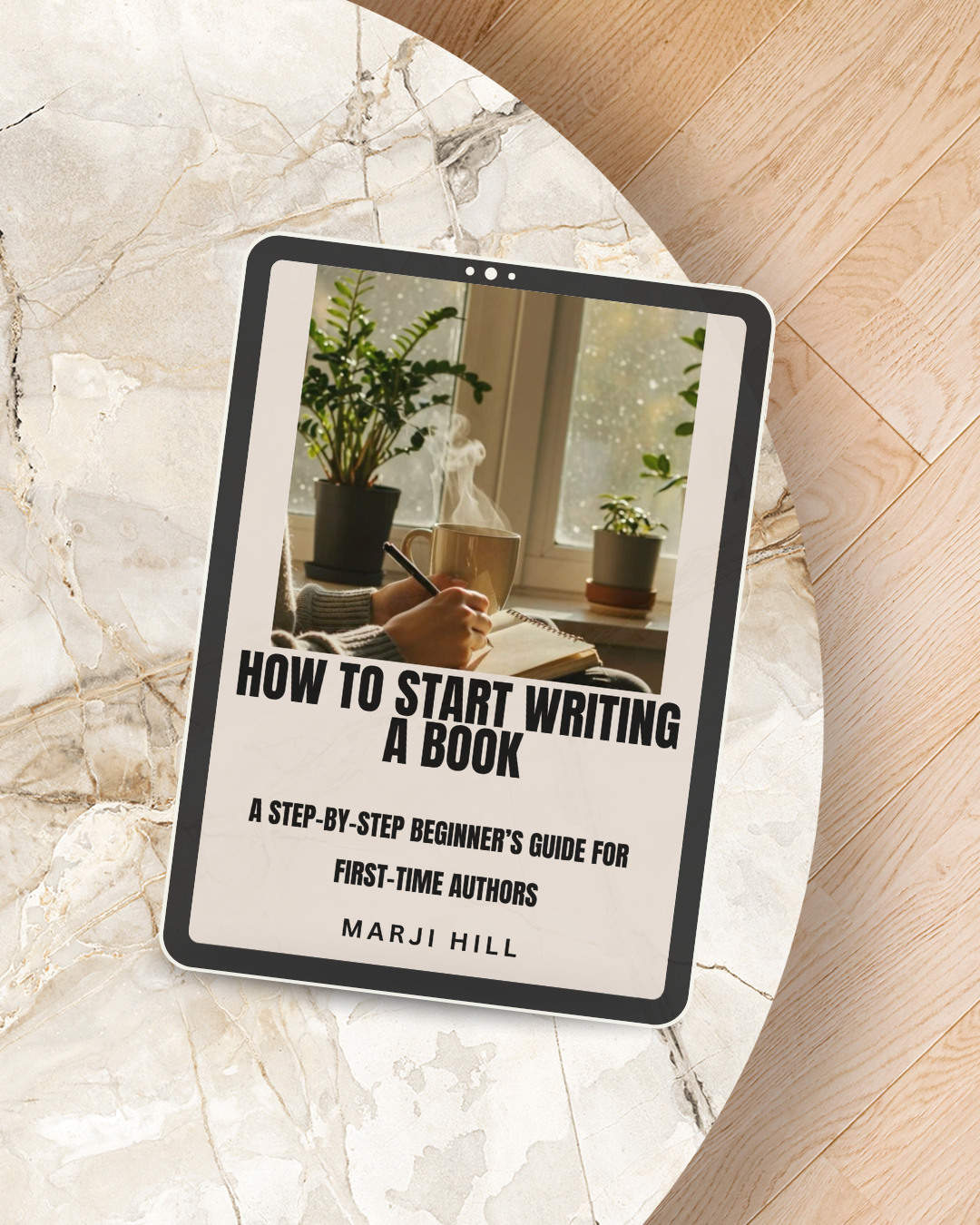
If you are unsure about how to start your writing a book then get your FREE ebook

Access Here

How To Start Writing A Book

Marji Hill

Author and Coach

A Writer’s Studio

A Writer’s Studio


Every successful author needs more than inspiration. They need a writer’s studio that encourages creativity, focus, discipline, and productivity.

Setting up a writer’s studio doesn’t have to be complicated or expensive, but it should be designed intentionally. Your environment affects your mindset, your energy, and ultimately your ability to produce quality work consistently.

Before we get started, please note that this post contains affiliate links. As an Amazon Associate, I earn from qualifying purchases. If you choose to purchase through these links, I may receive a small commission at no extra cost to you. Thank you for supporting my work and helping me continue to create helpful content for writers.

Stand-up desk


stand up desk

Personally, I use a basic table as my desk but if I was going to upgrade my writer’s studio I would consider investing in a stand-up desk.

When you create books you spend long hours at a computer, and sitting for hours can leave you feeling sluggish and tired. It is also bad for your posture.

A stand-up desk gives you flexibility. You can sit when you need to or stand when you want to increase energy and concentration.

Many writers find that standing while brainstorming, outlining a book’s content, or editing helps them think more clearly and stay alert.

Ergonomic chair

Ergonomic chair

The next chair I will get for myself is a quality ergonomic chair. If you are going to spend hours writing, comfort matters.

An old, poorly designed chair can lead to back pain, neck strain, and fatigue. An ergonomic chair supports good posture and helps you work longer without discomfort.

Your body is part of your productivity system, so taking care of it is essential.

Laptop computer

MacAir laptop


Technology plays a key role in a modern writing studio. My preference for writing books is a lightweight and reliable laptop such as a MacBook Air . I love my MacBook Air and recently I invested in a new one.

I think a MacBook Air is ideal for authors and they can last for years. It is portable, fast, quiet, and perfect for writing, editing, research, and online publishing.

Whether you are drafting chapters, designing book interiors, attending Zoom meetings, or uploading files to platforms like Amazon KDP or IngramSpark, a dependable laptop is the command centre of your publishing business.

Whiteboard

Another item that I can’t do without is a whiteboard. A whiteboard transforms your writing studio into a creative planning centre. You can map out book ideas, structure chapters, plan marketing strategies, and organise milestone dates.

Many writers think visually, and seeing ideas displayed clearly on a whiteboard helps reduce overwhelm. It also keeps your goals visible every day. You might write motivational quotes, set daily word count targets, or list deadlines to help maintain momentum.

Personalise your space

Finally, personalise your space. Add good lighting, maybe a plant, have your favourite books around, or artwork that motivates you.

Keep your writing space tidy and free from distractions. Your writer’s studio should feel like a professional environment where important work happens.

Remember, writing a book is not just a hobby. It is where you create intellectual property and potentially build a publishing empire.

A well-designed writer’s studio helps you show up consistently, think creatively, and turn ideas into finished books.

Marji Hill

Author and Coach

Smart Editing Secrets

Smart Editing Secrets


Smart Editing Secrets

Writing and editing a manuscript can feel overwhelming for many authors. After spending weeks, months, or even years writing a book, it can become difficult to clearly see mistakes, weak areas, or opportunities for improvement. ChatGPT with its smart editing secrets can become an incredibly valuable writing assistant.

Editing

ChatGPT can help authors edit their manuscripts faster, more efficiently, and with greater confidence. While it does not replace a professional human editor, it can dramatically improve the editing process and help authors polish their work before publication.

One of the biggest ways ChatGPT helps is by correcting grammar, spelling, punctuation, and awkward sentence structure. Authors can paste sections of their manuscript into ChatGPT and ask it to identify errors or improve readability. This can instantly clean up messy first drafts and make writing smoother and easier to understand.

Improve clarity and flow

Editing

ChatGPT can also help improve clarity and flow. Sometimes authors know what they want to say, but the wording may feel clunky, repetitive, or confusing. ChatGPT can rewrite paragraphs to sound clearer, more engaging, or more conversational while still keeping the author’s original ideas intact.

Structure

Another major benefit is structure and organisation. ChatGPT can help authors evaluate chapter flow, transitions, introductions, conclusions, and overall readability. It can point out repetitive sections, identify weak areas, and even suggest ways to strengthen the content.

Dialogue

For fiction writers, ChatGPT can assist with dialogue by helping conversations sound more natural and realistic. For non-fiction authors, it can help simplify explanations, improve headings, strengthen workbook exercises, and make information easier for readers to absorb.

Self-editing companion

One of the smartest ways to use ChatGPT is as a self-editing companion rather than asking it to completely rewrite a manuscript. The goal is to keep your own voice, personality, and creativity while using AI to refine and strengthen the writing.

Authenticity

The key thing to remember is that readers connect with authenticity. Your stories, experiences, ideas, and unique perspective are what make your book valuable. ChatGPT simply helps you present those ideas more clearly and professionally.

Used wisely, ChatGPT can save authors time, improve productivity, reduce editing stress, and help transform rough drafts into polished manuscripts ready for publication.

FREE eBook

How To Write A Book

If you are not at the editing stage yet and you want to write your book you may not know where to start. Many aspiring authors never begin because the process feels overwhelming.

Get your FREE eBook here and learn how to turn your idea into a finished manuscript.

Access your FREE

eBook.

How To Start Writing A Book


Marji Hill

Author and Coach

Build Author Visibility

Build Author Visibility


If you want to succeed as an author—especially in today’s self-publishing world—building an author platform is no longer optional. It’s essential. You have to build author visibility.

Author platform

An author platform is simply your ability to reach and influence readers. It includes your email list, social media presence, website, blog, and any community you build—such as a Facebook group or YouTube channel. In short, it’s your direct line to your audience.

Why Does It Matter

Why does this matter so much?

Because publishing a book is only half the job. The other half is getting people to discover it. Without an author platform, even the best-written book can remain invisible. But with a strong platform, you have a ready-made audience who already knows, likes, and trusts you.

Control

One of the biggest advantages of building an author platform is control. You are not relying solely on retailers or algorithms to sell your book. Instead, you can promote your work directly to your audience whenever you release something new.

Whether it’s a book, course, or digital download, your platform becomes your most powerful marketing tool.

Credibility

Author platform

Another key benefit is credibility. When readers see that you consistently share valuable content—tips, insights, stories—they begin to view you as an authority in your niche. This trust makes them far more likely to buy your books and recommend them to others.

Build relationships

An author platform also allows you to build relationships. Writing is often seen as a solitary activity, but publishing doesn’t have to be. Through your platform, you can engage with readers, ask questions, run polls, and create conversations. This connection turns casual readers into loyal followers.

The good news is that you don’t need to be everywhere. Start simple. Choose one or two social media platforms where your ideal readers spend time.

Show up consistently. Provide value. Be authentic.

Over time, your platform will grow—and so will your impact and income as an author.

In today’s publishing landscape, your platform is not just support for your books. It is the foundation of your entire author business.

Are you unsure about how to start your writing journey?

Access your FREE eBook.

How To Start Writing A Book

Marji Hill

Author and Coach

Time Fuels Writing

Time Fuels Writing
Time

If you want to build a successful book business you need to know how to increase productivity. It all begins with mastering one critical resource—your time because time fuels writing.

Let’s be honest. Most people describe themselves as “busy.” Busy with work, family, emails, and endless daily tasks. But there’s often a significant gap between what we think we’re doing with our time and what we’re actually doing. This is where a time audit becomes a powerful tool.

Time Audit

A time audit is simple, yet incredibly revealing.

Time audit

Over a 24-hour period—or ideally an entire week—track your day in 30-minute blocks. Write down everything you do. And that means everything. Record how long your meals take, how much time passes before you actually start working, your coffee breaks, phone calls, and social media scrolling. Even those “quick” distractions that quietly turn into 20 minutes should be included.

The key is honesty. Be thorough. Be brutally honest with yourself.

What you’ll discover is eye-opening. Patterns will emerge, and you’ll begin to see exactly where your time is going. You may uncover “time leaks” such as excessive email checking, unnecessary meetings, perfectionism, or constant interruptions. Social media alone can quietly consume hours without you realising it.

Learning To Say “No”

One of the most important skills you can develop is learning to say no. Not every request deserves an automatic yes. A simple response like, “Let me check my schedule and get back to you,” creates space for you to make intentional decisions about your time.

Your time is your most valuable asset—it’s the one resource you can never replace.

Take Control

Once you identify what’s draining your time, you can take control. Set clear boundaries, reduce distractions, and eliminate tasks that don’t align with your goals. Most importantly, create dedicated space for your writing.

When you master your time, you move from hoping to write a book… to actually finishing one. And that’s how books get written—and how publishing empires are built.

Learn more in my book on time management. This is an author’s guide on how to become more productive.

time management

Marji Hill

Author and Coach



From Manuscript to Marketplace

From Manuscript to Marketplace


From manuscript to marketplace

The Step-by-Step Self-Publishing Roadmap

Self-publishing has opened the doors for everyday writers to become published authors. If you’re a complete beginner, the journey from finished manuscript to marketplace and then holding your book in your hands can feel overwhelming. The good news? It’s simply a series of manageable steps.

1. Finalising Your Manuscript

Before you think about publishing, make sure your manuscript is truly finished. Complete your first draft, then step away from it for a short break. Return with fresh eyes and revise for clarity, structure, and flow. Strengthen weak sections, remove repetition, and ensure each chapter serves a clear purpose. This is where your book transforms from rough draft to refined manuscript.

2. Editing and Proofreading

Editing is not optional—it’s essential. Start with self-editing using tools and careful rereading. Then, if possible, involve beta readers for honest feedback. Professional editing (developmental or copyediting) is ideal if your budget allows. Finally, proofreading ensures your book is free from spelling, grammar, punctuation, and formatting errors. A clean manuscript builds credibility and reader trust.


self-publishing

3. Cover Design Essentials

Your cover is your book’s first impression. On platforms like Amazon, readers see your cover at thumbnail size—so clarity matters.

A strong cover should:

  • Clearly signal the genre
  • Use readable fonts
  • Have strong contrast
  • Look professional, not homemade

Study bestselling books in your category and model current design trends. If design isn’t your strength, consider hiring a professional or using quality templates.

4. Formatting for Print and eBook

Formatting ensures your book looks polished inside. For print, pay attention to trim size, margins, page numbers, headers, and chapter spacing. For eBooks, formatting must be responsive so it adjusts across devices like Kindle or tablets. Many authors use formatting software or professional outsourcing services (like fiverr.com) to avoid technical issues.

5. Uploading to Amazon KDP

Amazon’s Kindle Direct Publishing (KDP) allows you to upload your manuscript and cover, set pricing, choose categories, and add keywords. Your book becomes available worldwide through Amazon’s store. KDP is beginner-friendly and ideal for reaching online readers quickly.

6. Expanding Reach with IngramSpark

While KDP dominates online retail, IngramSpark expands your distribution to bookstores, libraries, and global wholesalers. If you want your book available beyond Amazon, IngramSpark is a powerful addition to your publishing strategy.


Book marketing

7. Launch Planning Basics

A strong launch creates momentum. Build anticipation before release, gather early reviewers, announce to your email list, and promote consistently during your first 30 days. Early sales and reviews help visibility and long-term success.

Self-publishing isn’t complicated—it’s structured. Follow the roadmap step by step, and you’ll move confidently from manuscript to marketplace.

Get More Tips

Do you want to learn more about writing and publishing your book? Then join the Fast Self-Publishing Online Facebook group.

Join Facebook Group:

Fast Self-Publishing Online


Marji Hill

Author and Coach

The Benefits of POD Publishing

The Benefits of POD Publishing


The benefits of POD publishing have completely transformed the publishing landscape.

For decades, publishing a book the “old way” meant large print runs, warehouse storage, and significant financial risk. Authors (or publishers) had to commit to printing thousands of copies upfront, hoping they would sell. If they didn’t, boxes of unsold books gathered dust — and drained budgets.

Today, Print-on-Demand (POD) platforms like Amazon KDP and IngramSpark have have changed the way authors go about publishing their books.

1. No Large Upfront Investment

Investment

Traditional offset printing requires bulk orders — often 1,000 copies or more — which means high upfront costs. POD eliminates this barrier. Books are printed only when a customer orders them. There’s no need to invest thousands of dollars in inventory before you know if your book will sell.

For new authors, this dramatically reduces financial risk and makes publishing accessible.

2. No Storage or Shipping Hassles

In the traditional model, authors often had to manage storage, packing, and shipping. With POD, platforms handle printing, shipping, and customer service. Whether a reader orders in Sydney, London, or New York, the book is printed locally and shipped directly to them.

This allows authors to focus on writing and marketing — not logistics.

3. Global Distribution

Global distribution

Platforms like Amazon KDP make books instantly available on Amazon marketplaces worldwide. IngramSpark goes even further by feeding its catalogue into major wholesalers, bookstores, and libraries globally.

Previously, gaining this kind of distribution required a traditional publishing contract. Now, independent authors can access professional distribution networks with a single upload.

4. Faster Time to Market

Traditional publishing timelines can stretch 12–24 months from manuscript acceptance to release. With POD, you can publish in days or weeks. This speed gives authors flexibility — you can update your manuscript, adjust pricing, or refine your cover quickly.

In a fast-moving digital world, agility matters.

5. Professional Quality Options

Modern POD platforms offer bookstore-quality printing, multiple trim sizes, paper options, hardcovers, and eBook formats. The quality gap between traditional and self-published books has largely disappeared — provided the author invests in good editing and design.

The Bottom Line

Print-on-Demand has made publishing accessible to everyone. It reduces financial risk, removes logistical headaches, provides global reach, and gives authors control over their work.

For today’s self-publisher, POD isn’t just an alternative to the old way — it’s a powerful, professional publishing solution.

Learn More

If you want to learn more about writing and publishing your book then join the Fast Self-Publishing Online Facebook group.

Join Facebook Group:

Fast Self-Publishing Online


Marji Hill

Author and Coach
Mindset Matters


Mindset Matters


Mindset matters

If you want to succeed as an author or self-publisher, there is the hidden superpower every author needs. Mindset matters is the one tool more powerful than marketing, ads, or even talent.

It’s your mindset.

Because at the end of the day, we become what we focus on.

Negativity

Life throws negativity at us from every direction — the news, social media, well-meaning family members, past failures, health challenges, money worries. It’s constant. And if we’re not careful, all that noise seeps into our thinking.

That’s where dreams quietly die.

Writing and self-publishing already require courage. You’re putting your ideas, your creativity, and a piece of yourself into the world. If your inner voice is whispering, “This won’t work… I’m not good enough… no one will buy this,” it becomes incredibly hard to move forward.

That little voice matters more than we think.

We talk to ourselves all day, every day — 24/7. And what we repeatedly tell ourselves shapes everything: our confidence, productivity, performance, and even our results.

Your brain believes what you feed it.

I often see authors say, “Self-publishing is too hard,” or “You can’t make money from books.” That kind of thinking becomes a self-fulfilling prophecy. When you expect failure, you unconsciously act in ways that create it.

Positivity

Mindset matters

But here’s the good news: positivity is a choice.

You can choose not to get swept up in the negative cycle. You can decide, “No — I’m going to succeed. I’m going to learn. I’m going to grow.”

When you picture success and expect good outcomes, you start behaving differently. You take action. You stay consistent. You keep going when others quit.

And that’s where momentum begins.

Build a stronger mindset

So how do you build a stronger mindset?

Start simple:

1. Surround yourself with positive thinkers.
Spend time with people who encourage you and believe in what’s possible.

2. Upgrade your self-talk.
Use daily affirmations. Speak them. Write them. Visualise your goals as if they’re already happening.

3. Feed your mind well.
Read inspiring books. Watch helpful videos. Listen to podcasts that energise you, not drain you.

Think of your mind like a garden. Whatever you plant grows.

So the real question is: what are you planting each day?

Mindset matters

Because a positive mindset isn’t magic — it’s a daily practice. And for authors, it might just be the difference between giving up… and publishing the book that changes everything.

Do you want to learn more about writing and publishing your book? Then join the Fast Self-Publishing Online Facebook group.

Join Facebook Group:

Fast Self-Publishing Online


Marji Hill

Author and Coach

Launch Of New Book Series

Launch Of New Book Series


Chinese Australians

Discover the untold story of the Chinese in Australia in this launch of a new book series.

Australia’s history is full of surprising and inspiring stories — and one of the most fascinating is the story of the Chinese in Australia. The Chinese Australians series by Marji Hill invites young readers to uncover this rich and often overlooked part of our past. Aimed at upper primary and lower secondary students, the series explores how Chinese people have helped shape Australia long before the gold rush — and continue to influence our nation today.

Across five beautifully written and researched books, students will travel through time — from ancient trade links to modern multicultural life. Each book in the series tells its own story, yet together they create a bigger picture of connection, courage, and contribution.

Book 1: Australia and China Before Captain Cook


Long before European explorers arrived, there were sea journeys, trade, and cultural exchanges between northern Australia and Asia. This book reveals the surprising connections between Australian shores and Chinese traders centuries ago.

Book 2: Early Chinese Migrants – The First Chinese Australians

Chinese Australians


Meet the early Chinese settlers who came to Australia in the 1800s as farmers, merchants, and labourers — and discover how they built new lives far from their country.

Book 3: Chinese and Gold – The Chinese on the Australian Goldfields


The gold rush drew thousands of Chinese miners to Australia. Their determination, teamwork, and resilience helped shape the goldfields — and the nation’s growing economy.

Book 4: The Chinese Experience – The Untold Story of Prejudice and Violence on the Australian Goldfields

Chinese Australians


This gripping book explores the darker side of Australia’s hidden history — the prejudice and violence faced by Chinese miners — and how they stood strong in the face of adversity.

Book 5: The Chinese Legacy – How Migration, Culture and Community Have Influenced Australia


From food and festivals to education and enterprise, this final volume celebrates the lasting legacy of Chinese Australians in shaping modern Australia.

Together, these books open a window into our shared history — a story of exploration, migration, and cultural transformation that continues to define who we are today.

For more on the series click the green button below.

Buy Now

Marji Hill

Author and Coach
The Power Of A Book Series

The Power of a Book Series


book series

The power of a book series can transform your author journey. Many new authors dream of writing that one great book — the story that captures hearts or the guide that changes lives.

But what if your first book was just the beginning? Writing a series — a collection of related books that share a common theme, topic, or storyline — can be one of the most rewarding and strategic moves an author can make. Each book can stand proudly on its own, yet together, they form a larger, more powerful whole.

1. Build Reader Loyalty

Readers love familiarity. When they fall in love with your characters, your world, or your teaching style, they naturally want more. A series keeps that connection alive. Rather than saying goodbye after one book, readers follow you from one title to the next — and that’s how loyal fans are created.

2. Make Marketing Easier

Book series

Marketing one book is hard work. But when your books are linked, every title helps promote the others. A reader who enjoys Book 1 is likely to buy Book 2 and Book 3. Algorithms on sites like Amazon even recommend your next title automatically. One ad or social media post can work for your entire series, multiplying your visibility.

3. Increase Your Income and Impact

A single book builds awareness; a series builds a career. Each new title boosts the sales of earlier books. You can also offer box sets, bundles, or themed collections. The more books you publish in a series, the more you expand your reach — and your income potential.

4. Strengthen Your Author Brand

A well-crafted series shows commitment, consistency, and expertise. Whether you write fiction or nonfiction, a series positions you as an authority in your field or a master storyteller in your genre. It signals to readers, teachers, and reviewers that you have something meaningful to say — not just once, but over time.

5. Keep the Writing Momentum Going


Building an author platform

Once you’ve established your world, message, or framework, writing the next book becomes easier. You already know your style, your audience, and your purpose. The creative flow builds naturally from book to book.

So, if you’ve written one book, don’t stop there. You may already have the beginnings of a powerful series — a legacy of stories or ideas that grow stronger with every volume.

Ready to Turn Your Book Idea into Reality?

If you’ve been dreaming of writing and publishing your book but aren’t sure where to start — let’s make it happen!

Book your FREE Strategy Session with me and get personalised guidance on how to plan, write, and publish your book successfully.

Simply send me a message via the CONTACT page by clicking the green button below and reserve your spot today.

Let’s bring your book to life!

Start Today


Marji Hill

Author and Coach

1 2 3 15